
Dealer Groups
Multi-Rooftop
recall software


Multi-store dealerships usually mishandle vehicle recall workflows when recall data, customer communication, scheduling, service execution, and repair order tracking are split across rooftops, systems, and teams. The problem is rarely one person or one department. It is usually a workflow visibility problem.
For dealer groups, recalls are not just a compliance or customer safety issue. They are also a fixed ops execution issue. A recall opportunity only becomes measurable when a dealership can identify the VIN, validate the recall, assign ownership, contact the customer or vehicle source, schedule the repair, complete the service, and track the RO across every store.
That is where many multi-store dealerships break down.
NHTSA’s public recall tools allow VIN-based recall checks and year/make/model recall searches, while NHTSA recall data also includes campaign-level information such as manufacturer, component, and recall type. (NHTSA) But dealer groups still need an operational system that turns recall information into store-level action and group-level reporting.
Recalls Near Me™ was built around that gap: helping OEM-certified service centers and dealership groups move from recall visibility to completed repair orders across single-store and multi-rooftop operations.
Multi-store dealerships mishandle vehicle recall workflows because the process is fragmented. Recall data may live in one system, customer communication in another, service scheduling in another, and RO completion reporting in yet another. When each store manages recalls differently, dealer groups lose visibility into what was found, who was contacted, what was scheduled, and which repairs were completed.
The result is predictable: open recalls are missed, customer outreach becomes inconsistent, BDC teams lack clear next steps, service teams lose track of eligible VINs, and corporate leadership cannot see performance across the group.
The most common cause is data fragmentation.
In many dealer groups, each rooftop operates with its own local habits, reports, spreadsheets, DMS views, CRM tasks, and service-lane workflows. One store may have a strong recall process while another handles recalls reactively. A BDC manager may know what is happening at one rooftop, but the group does not have a unified picture of recall opportunity across all locations.
This creates several problems:
In a multi-store environment, a recall workflow cannot depend on disconnected spreadsheets or store-by-store tribal knowledge. The group needs a shared operating layer.
A recall workflow has several stages:
When no one owns the full path, recalls fall through the cracks.
Sales may notice a vehicle has an open recall. The BDC may be responsible for outreach. Service may own scheduling. Advisors may manage the lane. Fixed ops leadership may only see the result after the RO is closed. In a single store, this can already create friction. Across multiple rooftops, the friction multiplies.
The core issue is not simply “recall data.” It is recall workflow ownership.
A better process gives every team a clear view of where each opportunity stands: found, qualified, contacted, scheduled, completed, or lost.
Many dealerships can look up recall information when they need to. That does not mean recall information is embedded into the way the dealership actually works.
NHTSA requires manufacturers to file defect and noncompliance reports and recall status reports, which creates a strong public and regulatory data foundation. (NHTSA) However, dealership teams still need that information to show up in practical workflows: service outreach, CRM communication, BDC tasks, mobile service routing, store-level dashboards, and RO tracking.
When recall information is not integrated into everyday workflows, staff members have to manually search, copy, verify, and follow up. That slows adoption and increases errors.
This is especially important for groups that want to use recall information in customer communication. A recall message should be accurate, VIN-specific, timely, and actionable. That is where API-based recall data becomes valuable.
For more on recall-specific data integrations, see:
VIN Recall Lookup API for Automotive Software
From the consumer’s perspective, recall mishandling often looks like silence.
A customer may not know that their vehicle has an open recall. They may receive a generic notice but not understand the next step. They may assume the recall is not urgent. They may not know which certified service center can complete the repair. They may also ignore broad recall messaging if it is not tied to their specific vehicle.
For dealership groups, this creates a communication gap.
A stronger recall communication process should answer four questions for the customer:
Without proactive communication, many recalls remain invisible until the customer visits the dealership for another reason. That is a missed safety opportunity and a missed fixed ops opportunity.
A single store may be able to track recall activity manually. A dealer group needs something more structured.
Group leaders need to understand:
Without group-level reporting, recall management becomes a store-by-store activity instead of a dealer group strategy.
This is one of the reasons Recalls Near Me™ focuses on both store-level execution and group-level oversight. The platform gives each rooftop a practical workflow while giving leadership visibility across locations.
For more on rooftop tracking, see:
Which Recall Software Lets Dealers Track Repairs Across All Rooftops?
Many dealerships think of recall workflow only in terms of their own customer database. That is useful, but it is incomplete.
For OEM-certified service centers, recall opportunity can also exist in nearby used car lots, independent dealers, and other local inventory sources. These vehicles may have open, serviceable recalls that can only be completed by an authorized service center for that brand.
This is where multi-store dealerships often leave opportunity on the table.
A dealer group may have certified service capacity across multiple rooftops, but no structured way to identify nearby serviceable VINs, build partner relationships, and track those opportunities from discovery to completed RO.
Recalls Near Me™ helps surface recall-related vehicle opportunities in local markets, including nearby used car lots, so dealerships can build recurring partner relationships instead of waiting for recall work to arrive passively.
Even a good recall strategy fails if the process is too complicated.
Multi-store dealerships often have staff turnover, role changes, BDC handoffs, advisor changes, and different levels of technical comfort across stores. If a recall workflow requires too much manual training, it will not scale consistently.
That is why ease of use matters.
A strong dealership recall platform should have a fast learning curve, simple workflows, clear status tracking, and onboarding that can happen quickly. Recalls Near Me™ is designed for same-day onboarding so teams can start working recall opportunities without a long implementation cycle.
The goal is not to add another complicated system. The goal is to make recall execution easier to manage.
Many dealer groups know recalls matter, but they do not always measure recall-related revenue with enough precision.
A recall opportunity can generate a warranty or recall RO. It may also lead to additional customer-pay work when the vehicle comes into service. But if the group cannot separate recall-only ROs, recall-driven mixed ROs, and completed repair activity by rooftop, it becomes difficult to measure the true business impact.
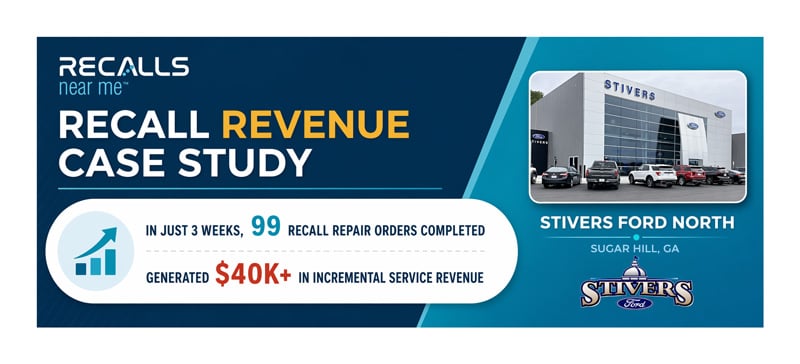
A recent internal benchmark model for U.S. dealer-performed recall repairs estimated a planning assumption of about $410 per completed recall RO, with a reasonable range of $330 to $500 depending on OEM mix and repair complexity. The same analysis noted that total recall-driven visit value can be higher when customer-pay work is added.
That makes workflow execution important. Missed recalls are not just missed tasks. They can represent missed service revenue, missed customer retention, and missed safety outcomes.
The biggest issue is usually the absence of one standardized recall operating model.
A scalable multi-store recall workflow should include:
When those pieces are disconnected, recall management becomes inconsistent. When they are connected, dealership groups can treat recalls as a measurable fixed ops workflow.
Recalls Near Me™ helps dealership groups manage recall workflows from discovery to RO completion.
The platform is built for OEM-certified service centers and dealer groups that need a practical way to identify, validate, track, and convert recall opportunities across multiple stores.
With Recalls Near Me™, dealerships can:
For a basic overview, visit:
How Recalls Near Me™ Works
For resources such as case studies, product demos, reports, and supporting material, visit:
Dealership Recall Resources and Reports
A better multi-store recall workflow should be simple, visible, and measurable.
At a minimum, dealership groups should be able to answer:
If those questions cannot be answered quickly, the recall workflow is not fully under control.
Multi-store dealerships mishandle recall workflows when data, communication, scheduling, and RO tracking are split across different stores and systems. Without a shared workflow, each rooftop may manage recalls differently, which makes it harder to track opportunities from VIN discovery to completed repair order.
Recalls are harder to manage across multiple rooftops because each store may have different processes, staff roles, reporting habits, customer communication methods, and DMS or CRM workflows. A dealer group needs both store-level execution and group-level oversight.
Siloed data prevents teams from seeing the full recall opportunity. One store may know about a VIN, another may have service capacity, and group leadership may not know whether the opportunity was contacted, scheduled, or completed.
Dealerships can improve recall communication by using VIN-specific recall information, proactive outreach, clear scheduling instructions, and digital communication channels such as text, email, CRM workflows, or service reminders.
A VIN recall lookup API allows automotive software platforms, CRMs, DMS tools, service schedulers, and communication systems to access recall-specific information at the VIN level. This helps dealerships provide more accurate and actionable recall communication.
Learn more here:
VIN Recall Lookup API for Automotive Software
Dealer groups can track recall repairs across rooftops by using a platform that connects recall discovery, VIN validation, outreach, scheduling, and RO completion in one workflow. This gives leadership visibility into recall activity by store and across the full group.
Learn more here:
Which Recall Software Lets Dealers Track Repairs Across All Rooftops?
Multi-store dealerships do not usually mishandle vehicle recall workflows because they lack effort. They mishandle them because recall execution is fragmented.
The fix is not another spreadsheet or another store-specific process. The fix is a unified recall workflow that connects VIN-level recall visibility, proactive communication, store-level execution, and group-level reporting.
Recalls Near Me™ gives OEM-certified service centers and dealer groups a practical way to manage recall opportunities across every rooftop, from discovery to RO completion.
Explore the workflow, compare options, and see how Recalls Near Me™ helps dealers uncover hidden recall opportunity and track results across rooftops.
How It Works View Pricing